Meeting of the Primates and Presiding Bishops
6 to 8 October 2026
Lambeth Palace, London SE1 7JU, England
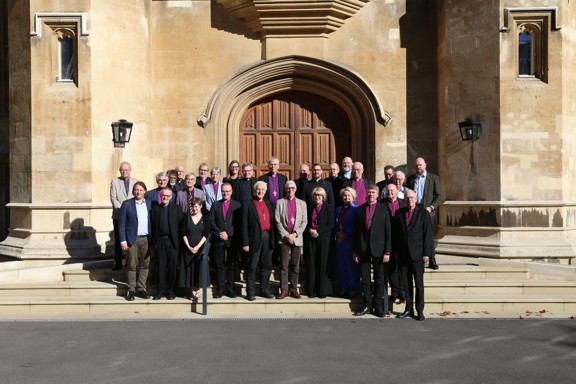
The Primates and Presiding Bishops of the Porvoo Communion met in London in the United Kingdom, together with members of the Porvoo Contact Group, during the 30th anniversary year of the Communion. The Porvoo Communion unites the Anglican churches of Great Britain, Ireland and the Iberian Peninsula with the Lutheran churches of the Nordic countries, the Baltic states and Great Britain. The Primates’ Meeting, which is usually held every three years, was centred on the theme “Being the Church in Turbulent Times”. The meeting was generously hosted by the Church of England at Lambeth Palace and included participation in Evensong at Westminster Abbey.
Prior to the full meeting, the Porvoo Contact Group reflected on the next steps towards establishing transitivity between the Porvoo Communion and the Anglican-Lutheran agreement in North America: namely, the Churches Beyond Borders agreement between the Anglican Church of Canada, the Evangelical Lutheran Church in Canada, The Episcopal Church (USA), and the Evangelical Lutheran Church in America. The Group was pleased to be joined by the Revd Dr Kirsten Guidero of The Episcopal Church, who offered insights from a North American perspective.
In a separate session, the primates and presiding bishops shared experiences from their respective contexts and reflected particularly on the need for a renewed ecumenical commitment between Anglicans and Lutherans. They agreed to prepare a statement on how the Porvoo Communion can achieve transitivity with the churches of North America, with the intent that this is shared within the individual member churches of the Porvoo Communion for further concrete action.
Building on the main theme of the conference, the Revd. Professor Luke Bretherton of Christchurch, University of Oxford, introduced the primates and presiding bishops to the question: “What is a Christian politics? And is there such a thing as a Christian nation?” Professor Bretherton underlined that politics is fundamentally concerned with the common good and seeks relational ways to advance it. From a Christian perspective, the basis of politics is love of neighbour. He noted the troubling return of a ‘friend-and-enemy’ dynamic, in which Christianity can be sometimes understood principally as constituting a nation (ethnos) rather than as the people of God (laos), and in relation to civic life as part of the demos (from which democracy takes its name). Ecumenism, mission and politics converge, he argued, when churches work for the common good in the light of faith, hope and love.
The theme of “Being the Church in Turbulent Times” continued with a visit to the Houses of Parliament at Westminster. There, the group learned about the role of the Church of England’s Faith and Public Life team within the formal structures of the nation’s political life, particularly in supporting bishops who serve in the House of Lords. The churches of the Porvoo Communion, especially the Lutheran churches of the Nordic countries, have their own histories of close cooperation with the state. Today, churches across Europe continue to seek ways of bearing witness together in the public sphere.
The Revd Dr Helen Paynter of Bristol Baptist College continued the theme with a presentation on “Christian Nationalism in the UK: Ideology, Theology, and Pastoral Responses.” Her contribution prompted reflection on how churches might challenge the unhelpful conflation of Christianity with political ideologies. She emphasised the importance of responding to Christian nationalist movements with careful theological engagement and suggested avenues for church leaders seeking constructive and dialogical responses.
The Archbishop of Canterbury, the Most Reverend Sarah Mullally, joined the primates and presiding bishops and the members of the Porvoo Contact Group for the final session. Reflecting on what it means to be the Church in turbulent times, she proposed three marks of Christian witness: being a community that remembers, a community that refuses fear, and a community that makes reconciliation visible. She reminded participants that the Porvoo Communion is more than a pragmatic or institutional arrangement: it is a gift of reconciled diversity, grounded in a shared sacramental life. The Archbishop encouraged participants to reflect on how this ecumenical gift enables the Communion to more fully live out the Gospel in our world today.
The theme provided an opportunity for rich discussion about the role and challenges of the Porvoo Communion in the years ahead. Future major gatherings of the Porvoo Communion will include a thematic consultation in Iceland in 2027, a theological conference in Finland in 2028, and the next meeting of primates and presiding bishops in Estonia in 2029.
LIST OF PARTICIPANTS
Primates and Presiding Bishops
Anglican
The Rt Revd Dr Jorge Pina Cabral (Lusitanian Church, Portugal; also a PCG member)
The Most Revd. and Right Honourable Stephen Cottrell SCP (Church of England)
The Most Revd. Dr Michael Jackson (Church of Ireland, Porvoo Contact Group Co-chair)
The Rt Revd Dr Carlos López Lozano (Spanish Episcopal Reformed Church; also a PCG member)
The Most Revd. and Right Honourable Dame Sarah Mullally DBE PC (Church of England)
The Most Revd. Mark Strange (Scottish Episcopal Church)
The Most Revd. Cherry Vann (Church in Wales)
Lutheran
The Rt. Revd. Jógvan Fríðriksson (Evangelical Lutheran Church of the Faroe Islands)
The Most Revd. Dr Olav Fykse Tveit (Church of Norway)
The Rt. Revd. Paulina Hławiczka-Trotman (Lutheran Church in Great Britain)
The Most Revd. Dr Guðrún Karls Helgudóttir (Evangelical Lutheran Church of Iceland)
The Most Revd. Dr Tapio Luoma (Evangelical Lutheran Church of Finland)
The Most Revd. Dr Martin Modéus (Church of Sweden)
The Most Revd. Peter Skov-Jakobsen (Evangelical-Lutheran Church in Denmark)
The Most Revd. Urmas Viilma, (Estonian Evangelical Lutheran Church)
Members of the Porvoo Contact Group
Anglican
The Rt Revd Dr Jorge Pina Cabral (Lusitanian Church, Portugal)
The Revd. Canon Stephen Fielding (Church of Ireland)
The Revd. Dr Matthias Grebe (Church of England)
The Revd Canon Dr Ainsley Griffiths (Church in Wales; Anglican Co-Secretary)
The Most Revd Dr Michael Jackson (Church of Ireland; Anglican Co-Chair)
The Rt Revd Dr Carlos López Lozano (Spanish Episcopal Reformed Church)
The Venerable Dr Leslie Nathaniel (Church of England – Diocese in Europe)
Ms Miriam Weibye (Scottish Episcopal Church)
Lutheran
The Revd. Dr Andris Ababuks (Latvian Evangelical Lutheran Church Worldwide)
The Revd. Bjarni Þor Bjarnason (Evangelical Lutheran Church of Iceland)
Dean Ovi Brim (Evangelical Lutheran Church of the Faroe Islands)
The Revd Dr Magnus Evertsson (Church of Sweden)
Ms Beate Fagerli (Church of Norway)
The Revd Dr Tomi Karttunen (Evangelical Lutheran Church of Finland)
The Rt Revd Dr Matti Repo (Evangelical Lutheran Church of Finland; Lutheran Co-Chair)
The Revd Dr Thorsten Rørbæk (Evangelical-Lutheran Church in Denmark; Lutheran Co-Secretary)
The Revd Meelis Süld (Lutheran Church in Great Britain)
The Revd Tauno Teder (Estonian Evangelical Lutheran Church)